Differential Patent Trolling as Law-Sensitive Innovation
Extending Differential Technology Development to the Legal Frontier
In IP geek circles, Manfred is legendary; he’s the guy who patented the business practice of moving your e-business somewhere with a slack intellectual property regime in order to evade licensing encumbrances. He’s the guy who patented using genetic algorithms to patent everything they can permutate from an initial description of a problem domain – not just a better mousetrap, but the set of all possible better mousetraps. Roughly a third of his inventions are legal, a third are illegal, and the remainder are legal but will become illegal as soon as the legislatosaurus wakes up, smells the coffee, and panics.
Accelerando - Charles Stross
What if we did this, for the public interest?Though, in the novel, Manfred can be public-spirited, in a way.
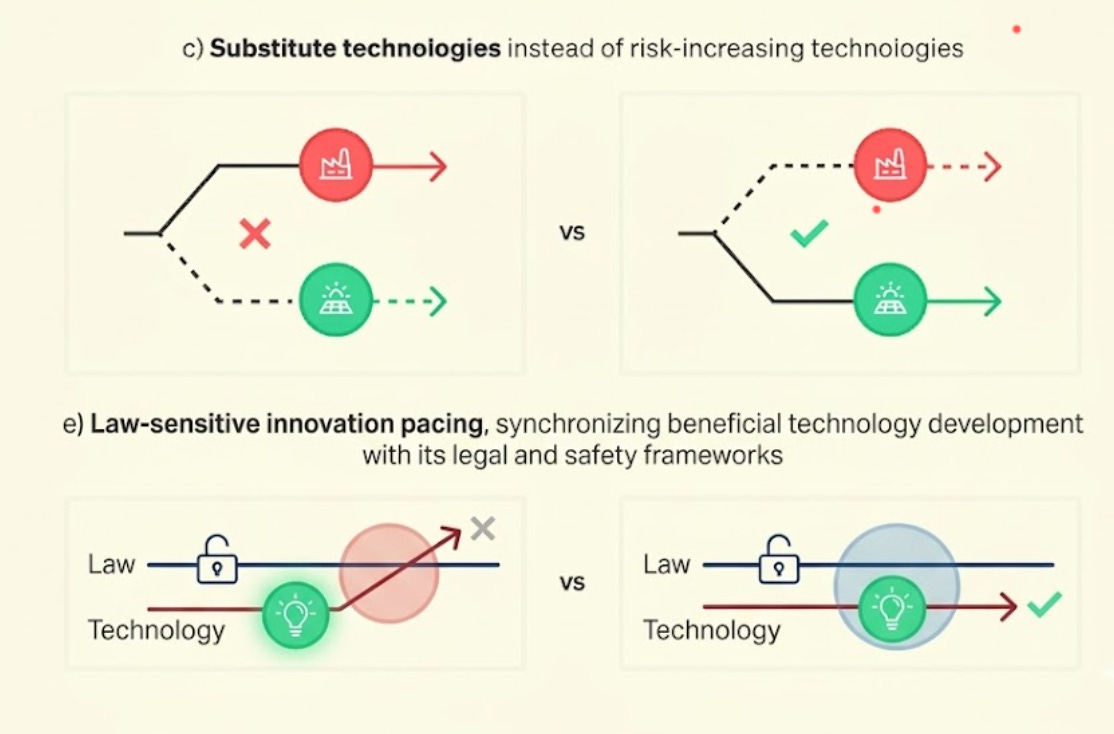
What if we should consider a new form of differential technological development, where the sequencing of technologies is pursued not just with an eye to safety sequencing, but with an eye to legal sequencing? Could we develop technologies in ways that are likely to affect their legal status or treatment, and therefore shape their accessibility and/or social effects?
Edited version of someone’s edited version
Flavours of differential technology development
Let’s back up: way back in 2002, philosopher Nick Bostrom introduced the concept of ‘differential technological development‘ (DTD)–‘trying to retard the implementation of dangerous technologies and accelerate implementation of beneficial technologies, especially those that ameliorate the hazards posed by other technologies.’. In his 2014 Superintelligence, he applied to explore how the timing of the development of advanced AI relative to other powerful technologies (e.g. nanotechnology), and how different combinations would affect overall levels of risk;He’s since been more interested in just the ‘optimal’ timing of superintelligence. finally, the idea also appeared in his 2019 Vulnerable World Hypothesis, as one aiming at:
Retard the development of dangerous and harmful technologies, especially ones that raise the level of existential risk; and accelerate the development of beneficial technologies, especially those that reduce the existential risks posed by nature or by other technologies.
This idea spun off in various directions: in the Rationalist community, Luke Muelhauser and Anna Salamon and others spun it into ‘differential intellectual progress “prioritizing risk-reducing intellectual progress over risk-increasing intellectual progress”. Elsewhere, Michael Nielsen sharpened some of ideas behind this, pointing out the ambiguity of categorizing what count as defensive or offensive technologies, while arguing that our society significantly under-prioritizes DTD as an overall approach.
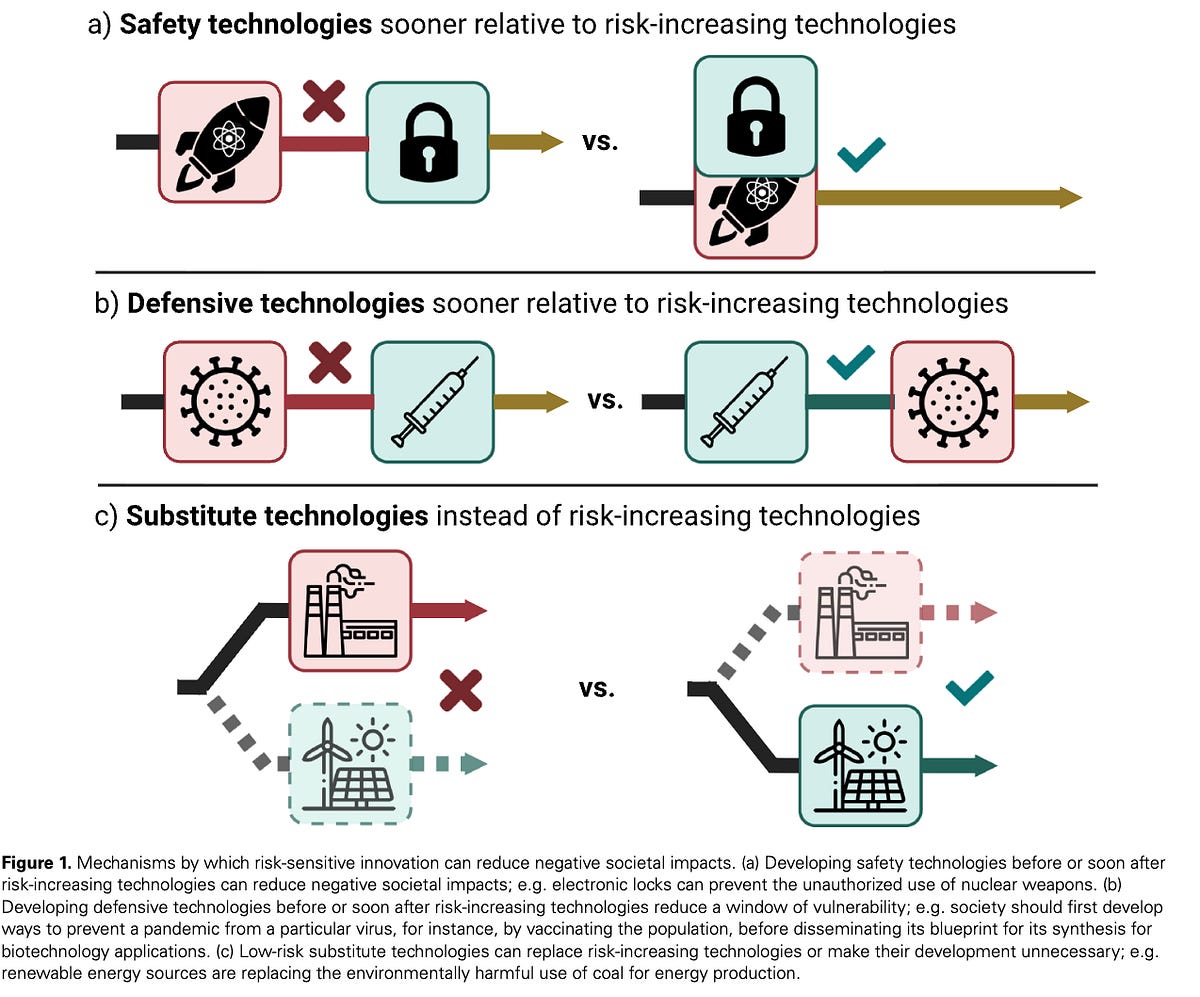
More relevantly for our current discussion; DTD was also operationalized by Jonas Sandbrink and others, in a great paper,Amusingly, the final published (post-peer review?) version lost the framing in the title (though not in all of the text) for the slightly-different framing of ‘risk-sensitive innovation‘. into a responsible innovation principle for navigating technology risks in many contexts. Their approach proposed the simultaneous slowing (where feasible) of dangerous or risky technologies along with the speeding up of (a) safety technologies (e.g. Permissive Action Links – nuclear weapons’ electronic locks), (b) defensive technologies (e.g. vaccines before the arrival of pandemics), and (c) substitute technologies (e.g. renewable energy sources versus coal for energy production).
(source)
This idea has gotten a lot of traction since. It has inspired Vitalik Buterin’s ‘Def/Acc’ philosophy, which emphasizes ‘decentralized and democratic, differential defensive acceleration‘. Luke Drago of Workshop Labs has proposed leveraging AI researcher pressure and counter-markets to differentially accelerate ‘augmentative’ AI as a substitute technology to automative (i.e. fully replacing) AI. Some of my colleagues have looked at how law could help speed up (or get out of the way of) the development of ‘defensive technologies’ that mitigate risks from AI; for its part, the Institute for Progress has made the acceleration of ‘defensive and verification’ technologies part of their ‘Launch Sequence‘.
Further expansions of DTD: cooperative tech; humanitarian R&D
There are further extensions of the idea: in the AI safety field, DTD has implicitly or explicitly underpinned proposals for investments in accelerated privacy-preserving ‘hardware-enabled mechanisms’ (i.e. embedded security systems across the AI hardware stack and on AI chips) in order to make available the set of ‘assurance technologies‘ with which states could assure one another’s compliance with future AI-focused international agreements.A similar idea underpins my work on Treaty-Following AI. In fact, this arguably shows a broadening of the DTD-concept: ‘verification-enabling technologies’ might be considered a form of defensive technology acceleration; but they are also arguably a distinctive form of differential tech development, one aimed at advancing (inter-state) cooperation-enabling technologiesWhat Allan Dafoe and others, avant la lettre, called ‘cooperative capabilities‘. ahead of the expected challenges they are meant to address.
Finally, as part of the IFP Launch Sequence, Tim Fist, Tao Burga, and Tim Hwang have also proposed a fourth form of differential technology development, suggesting that policies should also generally aim at ‘humanitarian R&D‘: i.e. the acceleration of underprovided beneficial technologies, even absent any risk-increasing technology, simply where there are market failures that the private sector will not explore by default, or quickly enough.
Law as the DTD Final Frontier
Why stop there? Why not work on changing the sequencing of (anticipated) technologies with an eye to shaping their likely legal status or classification–and, with that, their accessibility or social effects–once they do appear on the scene? The aim here is basically to strategically sequence who develops what technologies, under what institutional conditions, to mitigate risks and ensure favorable access and usage regimes.
This could work by various routes:
Speed up legally open-source or public versions of a beneficial technology over enclosed ones (e.g. differential patent trolling). I.e. consider technologies that would be hugely beneficial primarily (or exclusively) if they are widely available, or developed open-source–in order to ensure they are developed on those terms, rather than under regular commercial or intellectual property conditions. In some sense, this strategy is already practiced in a range of ‘humanitarian R&D’ cases: The Drugs for Neglected Diseases initiative (DNDi) develops treatments outside the patent system specifically to prevent enclosure; as does the Open Source Malaria project; similarly, the Open Source Seed Initiative aims to allow plant breeders to designate new crop varieties as open-source, aiming to keep crop genetics outside plant patent regimes before agribusiness encloses them. In a way, this might just be a pro-social form of (or, if you will, counterpart to) patent trolling.
Shift the timing, and with it the technology metaphors that are likely to be prevalent at the time the technology arrives; since, as I and others have previously chronicled, such foundational metaphors will often help set the regulatory agenda for legislators, shape the policymaking process;Of course, as Margot Kaminski and Meg Leta Jones have shown, there may still be a lot of variation in how the law constructs a technology within different fields and domains. For instance, they note how “the First Amendment governs “speech” and “speakers” toward a number of theoretical goals, largely through the court system. This leads to a particular set of puzzles, such as the fact that AI systems are not human speakers with human intent. But other areas of the law construct AI systems very differently. Content-moderation law regulates communications platforms and networks toward the goals of balancing harms against free speech and innovation; risk regulation, increasingly being deployed to regulate AI systems, regulates risky complex systems toward the ends of mitigating both physical and dignitary harms; and consumer-protection law regulates businesses and consumers toward the goals of maintaining fair and efficient markets. In none of these other legal constructions of AI is AI’s lack of human intent a problem.” affect which agencies (or even branches of government) are seen to have a mandate to act; or critically, inform and condition courts’ treatment of a technology in any court cases that arise.Sure, you might argue that this is best achieved not by shifting the timing of the technology, but rather by just engaging in the debate over what are the appropriate technology metaphors. However, which are the appropriate technology metaphors will also be affected by developments in many other industries, technologies, and fields, such that in some cases it may genuinely be easier to try to match the pacing of a particular technology to the landscape of the metaphors, than to try and steer the entire public conversation.
Time a technology’s arrival to coincide with anticipated political cycles or conditions favorable to desired legislation. For instance, one can try to speed up or delay a technology’s arrival to arrive during administrations or governmental coalitions judged more likely or more empowered to pass desired regulation around the technology; or to arrive early during a Presidential ‘honeymoon’ period.
Pace the release of breakthrough capabilities in packages, in order to create a more visceral public and legislative sense of the urgency and novelty of a technology (and the need for new law), or to avoid a boiling-the-frog effect, complacency, or inappropriate deferral to outdated regimes.
Co-time breakthroughs with other (anticipated) technological breakthroughs in other fields, either to forestal anticipated harmful regulation (by banking on the other issues pushing it off the agenda), or to facilitate their inclusion in a concerted omnibus regulation.
Slow technology to ensure particular public coalitions are given adequate time to converge and assemble before it is too late; or conversely speed up a technology in order to compress its impacts, provide a clearer, unambiguous ‘fire alarm‘, and spur various interest groups into a simultaneous awareness of their shared interest in pressuring for its regulation as a larger coalition.
Time it in ways that anticipates ongoing legislative and judicial developments (e.g. regulatory updates; sunset clauses), in order to reduce inadvertent legal uncertainties or overlaps in the law applicable to the technology, when it arrives; for instance, alter the speed of development of a technology to make sure it arrives before/after a potential applicable legal precedent is established on the basis of ongoing court cases in adjacent domains (e.g. social media regulation).
To be clear, I don’t know that all of these are equally feasible: a number of them presume fairly granular and accurate predictions of the future development of political cycles, public discourse, and especially judicial approaches (is such legal forecasting feasible? I don’t know. I don’t think it has been sufficiently tried or explored). I also don’t know that all of them are equally wise: many of these strategies are themselves risky or perhaps even harmful; there’s a risk that many of these strategies would be brittle, or easily countered by competitors; and that if they failed, they would not do so gracefully.
Still, it is interesting to consider that differential technology development might be more sensitive or even directly responsive to anticipated future legal conditions, in ways that are relevant to both risk reduction and benefit realization. And that there could even be projects intended to serve public interest, through a form of temporal legal arbitrage.
Comment on Substack · Subscribe to Critical Maas · All essays