Is the Illusion of Technology Loss an Illusion?
Oh the Humanities / Modern Memory Palaces? / Forgotten vs. Withered tech branches
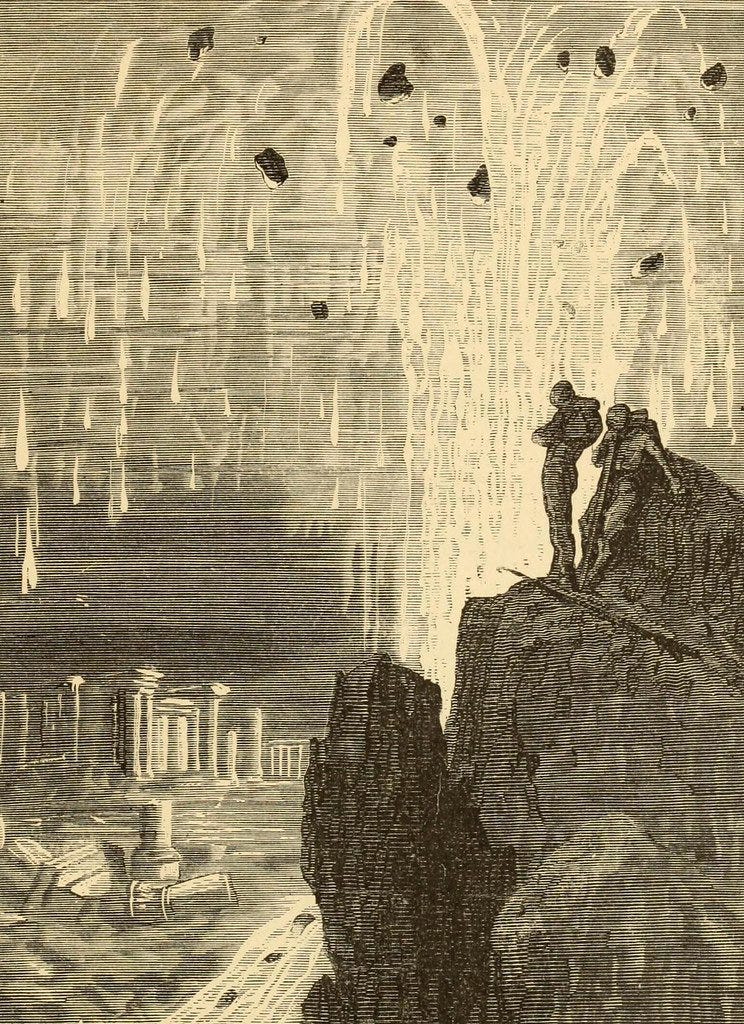
Alphonse de Neuville (1875) There, under My Eyes, Destroyed, Ruined, Lay a Town
The Illusion of Technology Loss
In my last essay, I reviewed ~70-odd proposed ‘lost’ technologies.Part of a series on the history of technological contingency & the future of AI, etc. At first glance, this appears to find that (as Étienne Fortier-Dubois has previously argued) truly lost technologies are, in fact, much rarer than you would expect, based on the strength of the idea in e.g. popular culture.
It turns out that many proposed examples of loss concerns semi-mythical technologies that never were (‘memory mirages’), or technologies that are, in fact, around but just retired from production or general use, or which are absent but could be relatively easy to reconstruct should we ever want to (‘senescent tech’). There are very few serious examples of entirely exhausted technology-enabling resources or materials;Though some resources, such as helium, low-background steel, or certain metals or rare earths might be on track to achieve that status in the next century (all else equal). and although there are some outstanding mysterious artefacts that served unknown purposes, many other technologies that were once enigmatic in their workings (e.g. Maya Blue; Roman concrete; Damascus steel) are beginning to yield their secrets to modern science.
Of course, that does not mean that technology has always been robust and self-healing: there is a genuine premodern history of ‘prodigal’ technologies—i.e. technologies that were lost and only recovered or reinvented much, much later. Even if such losses were, ultimately, ‘temporary’, their lengths were far from insignificant blips. Some innovations genuinely vanished for centuries or even millennia before their reintroduction. In that sense, a degree of lossy forgetfulness (or susceptibility to the ‘great sieve’ of history) might still be the historical norm for most societies across history.
However, over long enough timeframes, it seems that few technologies (that we know of/remember) that were once achieved, are lost forever. Does that mean that our cultural depictions of lost technologies are essentially an illusion? I think it is a useful corrective, but there are some limits to that idea, which we can understand based on some reflections on the questions:
why do we (seem) to lose art and knowledge at high rates, but not technologies?
Is the modern world more resilient to technology loss, or less, or differently?
What actually matters in a societal perspective: the (rare) forgotten tech tree branches? Or the (fairly widespread) withered branches that have since their stasis seen key industrial bases or tacit knowledge dissipate?
Oh the Humanities: Why Did We Lose Knowledge and Art, But Not Tech?
The apparent resilience of premodern tech tree branches appears puzzling. Given the massive track record of cultural and informational loss throughout history, why do practical forms of ‘techne’ (i.e. technology) appear to be so much more resilient to (at least enduring) loss than cultural products (i.e. arts), or than knowledge?Or, to riff on Nick Land: why is it that almost nothing human makes it out of the deep past?
Some potential explanations include:
Materiality: Perhaps technological products are (more often) material; or (due to their utilitarian nature) made of more hardy materials; and so are effortlessly self-perpetuating in a way that e.g. oral traditions or many fragile artistic products simply aren’t?
Utility: Perhaps (practical) technologies are just more ‘useful’ than cultural products, to a greater number of actors, and so are more prioritized where it comes to preserving them?Though I’ve previously argued that it can be surprisingly hard to objectively establish the relative importance of various technologies across different societies, I think it’s more feasible to describe practical technologies as having greater practical utility than arts.
Scale: perhaps artistic products are less likely to survive as they are usually fewer in number than practical artefacts, e.g. because they were marketed at a smaller, literate elite population (or, in the modern era, because they derive their perceived value from their rarity)–and therefore they are more susceptible to being lost wholesale?
(Re)Convergence: perhaps there is a degree of convergence for many (even if not all) technologies, which means that many technologies are more likely to be ‘re-generated’ in some form after they are lost, whereas cultural products or knowledge are by their nature of their particular time, and so more divergent;
Compression difficulty & artistic antimemetic properties: maybe it is simply harder for people to memorize a detailed artistic product (e.g. a painting) or a complicated knowledge base (e.g. extremely detailed historical records) in sufficient working detail to reconstruct it from scratch after a fire. In contrast, technological knowledge, at least for simple premodern artefacts, is ‘memetically self-repairing’: next generations just need to remember the overall working principles at play (e.g. the ‘trick’ or physical phenomena it leverages), after which the specific implementation of the technology can be quasi-reinvented through trial and error.
Network embeddedness (e.g. ‘sociotechnical irreducible complexity’): perhaps the loss of a technology is more likely to be quickly noticed or keenly felt, because many technologies are necessary to other technologies built with- or on top of them? As such, they are more likely to themselves be maintained or preserved or recovered, because their incidental loss, if not remediated or substituted, is immediately and completely crippling for all downstream or dependent technologies. By contrast, a cultural artwork may have been inspired by (or even may refer to) many preceding works, without needing those works to remain extant in order to itself serve its purpose.
I think there is something to these explanations. But also: perhaps the seemingly greater loss of cultural products compared to technologies is just an illusion? A measurement (…er) artefact of how we ‘count’ cultural versus technological products?
I think this gets into difficult territory about what actually ‘is’ a technology, and how you would go about counting (or compare) technologies. However, I think you can argue, as Étienne Fortier-Dubois has, that whereas the instruments (e.g. musical instruments), materials (e.g. pigments), or implements (e.g. pencils) used in artistic production should count as ‘technologies’, the particular artistic pieces or products thus produced with them are not themselves technologies.
And, sure, you might say that is just a semantic argument; but I think it still gestures at the relevant difference in what, actually, is easily lost to the Great Sieve of history: particular artistic products are fragile; but the underlying technologies (techniques, materials, etc) may often prove more robust. Moreover, the fact that innovation is often combinatorial and continuous makes it harder to split the difference between particular closely-adjacent artefacts (e.g. types of bows). This helps explain how, when we (indirectly) learn of the loss of a particular philosopher’s manuscript, this can feel like a more distinct (and irrecoverable) loss than that of a particular design of hammer. So, we are just predisposed to count individual lost works by philosophers as ‘lost’ artefacts (even if we retain examples of other works by other philosophers), yet not count individual lost hammers as ‘lost’ hammers (even if we lost most examples or instances of a type of hammer).
Our Modern Memory Palace: will we never again lose technology?
Naively, we might expect technological forgetting to be a thing of the past, now that we have USB drives and Dropbox and tens of millions of public libraries and homes holding tens of billions of books (e.g. nearly a billion physical books are sold each year in the US alone; and throughout history we’ve accumulated around 158 million unique books throughout history).
So, are we impervious to technology loss? Étienne Fortier-Dubois concluded his previous historical roundup arguing that:
…loss of technology is not impossible. But to an innovative and large culture like modern human civilization, it’s not really something that happens.
I think that while this is generally true, there are at least two relevant caveats.
First, some of the cases of even temporary technological loss in the modern era (i.e. ‘modern prodigal technologies’) suggest that temporary loss of a complex, high technology can well occur, especially when (re-quoting):
(1) a technology is highly classified or secret;
(2) the technology’s original design was dependent on iterative, theory-free engineering, such that the engineers may not have an explicit understanding of all its parts and their contribution to the final design;
(3) the technology is heavily dependent on tacit knowledge or on many bespoke production components that themselves have been discontinued, and/or
(4) the technology is abandoned or phased out for some time
‘Some time’ here, can be surprisingly short—in the cases of FOGBANK or Polaroid film reagent chemistry, less than a decade after production lines close.
Moreover, the cases of data- and information loss imply that informational loss can occur fairly prominently in our modern era, especially in conditions where a data storage technology is novel or immature; or where it is more centralized (or decentralized but more vulnerable to common-mode failures) than is widely understood.
More generally, our modern information and archival technologies seem to have various traits which make our civilizational memory a strange combination of robust and fragile.
Jagged resilience: in at least some technological domains, our technological ambitions may be growing faster than our ability to commit them (entirely) to memory. Even though our recording technologies have gotten better, more redundant and more decentralized (in ways that imply a far greater aggregate technological resilience today), the technological systems we attempt to construct may in some areas be getting far more complex, dependent on many subsidiary components and on tacit knowledge. That likely makes it more difficult for us to easily recover them from a standing start should they ever be lost, even if the blueprints are saved.
Perishable ‘active storage’: digital storage media degrade faster than paper or stone; and in fact many media formats become unreadable over time as technology moves on, creating the risk of data being trapped in old digital media storage (e.g. floppy disks). As such, what appears to be a trend towards more impervious civilizational memory may be an achievement of sheer quantity (the sheer mass of copies), rather than of quality.
Information overload: the amount of information grows so rapidly that, in many cases (and web archive notwithstanding), people are not making an adequate effort to preserve information (as in the case of link rot). This means that we can rely on our civilization to maintain (records for) knowledge and technological components that we already know are very critical or valuable; but not for data which we might only later, in retrospect, know to weight adequately.
And, in principle, that makes sense! Digital storage shows that a quantity-based approach, involving cheap copies, automatic back-ups, regular transfers across to new substrates, can be more robust overall. But it does mean that our archives depend, to a historically unprecedented degree, on our active (and fairly uninterrupted) effort, upkeep, replacement, and transfer.
Of course, perhaps this isn’t really a unique feature of our archival or information storage technologies. Maybe maintaining any of our civilizational functions by its nature requires immense, constant effort, and energy input: perhaps complex civilization is simply a dissipative system: a dynamic ordered pattern that exists only so long as you invest energy in it.As one old programmer classic puts it: “Remember that stuff about crazy people and bad code? The internet is that except it’s literally a billion times worse. Websites that are glorified shopping carts with maybe three dynamic pages are maintained by teams of people around the clock, because the truth is everything is breaking all the time, everywhere, for everyone. Right now someone who works for Facebook is getting tens of thousands of error messages and frantically trying to find the problem before the whole charade collapses. There’s a team at a Google office that hasn’t slept in three days. Somewhere there’s a database programmer surrounded by empty Mountain Dew bottles whose husband thinks she’s dead. And if these people stop, the world burns. Most people don’t even know what sysadmins do, but trust me, if they all took a lunch break at the same time they wouldn’t make it to the deli before you ran out of bullets protecting your canned goods from roving bands of mutants.”
However, even if this is a sensible path in some ways, it does imply that our civilizational memory for technologies may be both generally robust across most classes of prosaic or mid-tier technology, yet also more vulnerable to losing particular classes of technologies or information, especially in scenarios of regional or global disaster that disrupt multiple parts of our digital infrastructure. That is, we are very unlikely to lose the wheel again; but we have no guarantee of keeping many technologies that we could not rebuild from a reasonable standing start.
What actually matters? Less ‘lost secrets’, more ‘withered branches’
The historical track record seems to suggest that Kevin Kelly is at least somewhat right: once invented, few technologies (that we know of) have been truly lost, in a way where they weren’t eventually recovered, reinvented, or surpassed in another way. Technological practices have been lost, but they do seem to be genuinely more historically durable or resilient than artistic products or other forms of knowledge.
Yet, while Kelly might interpret this as a testament to the inexorable growth of what he calls the ‘Technium‘, I’m less sure. Whether a technology is ‘lost’ or remembered appears to matter far less than whether it is seeing active production or not.
That is, there are many technologies that are (technically) not ‘lost’; but which are today either extremely rare, or which have been mostly abandoned and are functionally costly to revive, or taboo to research further. Supersonic airliners; ternary computing; pneumatic-tube underground postal networks; spacecraft sea launch; over-the-horizon radar; (arguably) viral phage therapy; (arguably) advanced nuclear weapons designs for given aging expert communities and bans on further testing; and a whole range of more local industries such as US and UK shipbuilding expertise.I’ll make a more comprehensive list in some future post. These technologies clearly are remembered, and remain possible; and so could be reconstructed or revived. And perhaps some will be. But doing so may take even previous industry leaders years to spin up their industrial base; to re-train new experts to replace retired generations; and to re-acquire or (functionally) re-discover key tacit knowledge.
In the meantime, though, these technologies (no longer) exert much relevant pull on either the world or on its trajectory across the tech tree. While they are latent, they are not being improved; do not attract masses of new talent to skill up or apply their work to addressing its problems; are not being actively recombined with all other technologies invented since their phasing out; are not visible or attractive or competitive as a frontier of investment; and may increasingly yield the field to other, even narrowly inferior technologies that are able to establish a moat of ecosystem lock-in.Matt Clancy: “Finally, technological inertia can also be sustained because of the high costs of switching to an alternative paradigm. Technologies tend to be useful in a broader ecosystem of complementary technologies and this can stymie the prospects of a new and different technology. A new technology may be better along some metric, but if realizing these benefits requires switching many complementary technologies too, the cost of switching may deter adoption. This can prevent the new disruptive technology from gaining the kind of traction that would allow it to benefit from the rich-get-richer evolutionary dynamics discussed above. If your technology is better than all the alternatives, but nobody uses it, then it might not be better for long. In evolutionary models of technological progress, it is the most widely used technology that attracts more R&D attention and continue to improve.” In short, you could decide to try and regrow a withered tech tree branch any day; but you can’t grow new buds from it before you do.
Comment on Substack · Subscribe to Critical Maas · All essays