Premodern Tech Tree Divergence: A List
Did isolated civilizations historically converge on the same technologies? No
Part of a series on the Historical Mechanics of Technological Contingency.
TLDR: it has been claimed that independent historical convergence of isolated civilizations on the same technological solutions shows that the functional branches of the tech tree are restrictive, pre-determined, and do not allow much variation or choice. Against this idea of strong historical convergence, I list and briefly review ~120 cases of technological divergence in pre-modern societies, across 18 technology domains, and discuss patterns and implications.
I. The Civilizations IV view of the convergent technology tree
Did historical societies discover different sets of technologies? Er, yes, obviously. Few would deny that historical societies have differed greatly in the set of technologies they utilized.
Yet, in a different view–one that sees technology as an inevitable, rational force that is unfolding unstoppably along pre-determined channels–such variety is misleading or surface-level at best.
Call this the (Sid Meier’s) Civilizations IV theory of history:See also Étienne Fortier-Dubois: “The tech tree can be traced to the 1980 board game Civilization, widely popularized by game designer Sid Meier’s video game version in 1991. The tech tree in Civilization functions as a branching pathway of scientific discovery that unlocks new units, buildings, and abilities — from primitive tools to space-age technologies. The story goes that Meier threw the tree together on only cursory research, with the intention to eventually come back and make the “real tech tree” later. But this initial version was so fun that it stuck.” in this view, history is the stage on which societies run an iterative, competitive search (by unguided trial-and-error at first; and, eventually, through theory and the scientific method) to uncover the next branches of the tech tree. If they manage to do so, they unlock increasingly powerful technological solutions to biologically or socially irreducible problems (e.g. sustenance; shelter; security).


*Better start climbing that tree
This theory of macrohistory assumes that there are only some narrow bands of technologically optimal solutions. These few suitable branches will outperform any others, and which will displace any inferior alternative technological paths, whether by attraction and diffusion or by competition and conquest. This is a model of a punishing, restrictive technology tree, which only offers a narrow set of fertile branches towards efficient technologies, and so closely constrains the sequence and direction of technological development to particular, inevitable paths. If this model of a restrictive technology tree is true, we cannot meaningfully speak of ‘choosing’ between different branches–there is no sense in trying to ‘hold back the tide’ on an optimal branch, especially since There Was No Alternative.
While advocates of this view may admit that societies differed in their technologies and practices, they explain such variation as either the result of underlying differences in the environment civilizations find themselves in,I’ll discuss this objection in a next follow-up post, to highlight that, while this explains *some* of the variation we see, it does not explain all. or as degrees of freedom that are afforded only to relatively ‘superfluous’ technologies (e.g. cultural technologies), but never in the hard core of critical technologies which represent the most efficient solutions to societal problems available at a given tech level–solutions that all, or at least all sufficiently complex and competent societies, must end up grappling towards.
The argument from independent historical technological convergence
One argument for the idea that the tech tree is quite functionally restrictive, is the historical track record of (seeming) independent technological convergence, whereby different, long-isolated civilizations end up discovering the same set of technologies (again, modulo available local resources) in parallel.
For example, in the Mechanize manifesto for technological inevitability, Barnett, Besiroglu and Erdil take up a version of this argument. They claim that, when the Spanish arrived to the New World in 1519, after over 10,000 years of civilizational separation, they found a culture that was dissimilar in a number of (surface) ways (language, cultural tradition, deities), but that:
…for all their differences, there were also many striking similarities. Both had independently developed intensive agriculture with irrigation and terracing. Both designed their cities using rectangular street grids centered on public plazas. Both utilized the concept of zero, wove cotton into dyed clothing, used currency for trade, and built monumental stone architecture. Both were hierarchical societies that featured a monarch at the top, a hereditary nobility, bureaucracies to administer taxation, and standing professional armies. (…)
They further argue that this was not just a single case, but that “this pattern is normal, not unusual. Civilizations separated by vast distances and time independently developed metallurgy, the wheel, writing, and bureaucratic states.”
This is a compelling and useful argument. After all, what are the chances that the very same invention would be hit upon twice, by inventors hailing from radically different cultural frames of reference, unless that invention is either (once you consider it) the only logical, obvious solution, or if no other technology will cut it?
Yet, are they correct that this is a normal pattern? Both in the case of the Aztec/Spanish, and in general, across history? In this post I’ll review the historical evidence, focusing initially on premodern societies.I’ll leave the question over post-contact technological dissemination and convergence, as well as convergence in modern, post-industrial revolution technologies, for future posts.
This will be a fairly lengthy list and review of cases, so I’ve marked out the different technological classes below, and offer some summarizing thoughts.
II. The Spanish and Aztec considered as different civilizations, actually
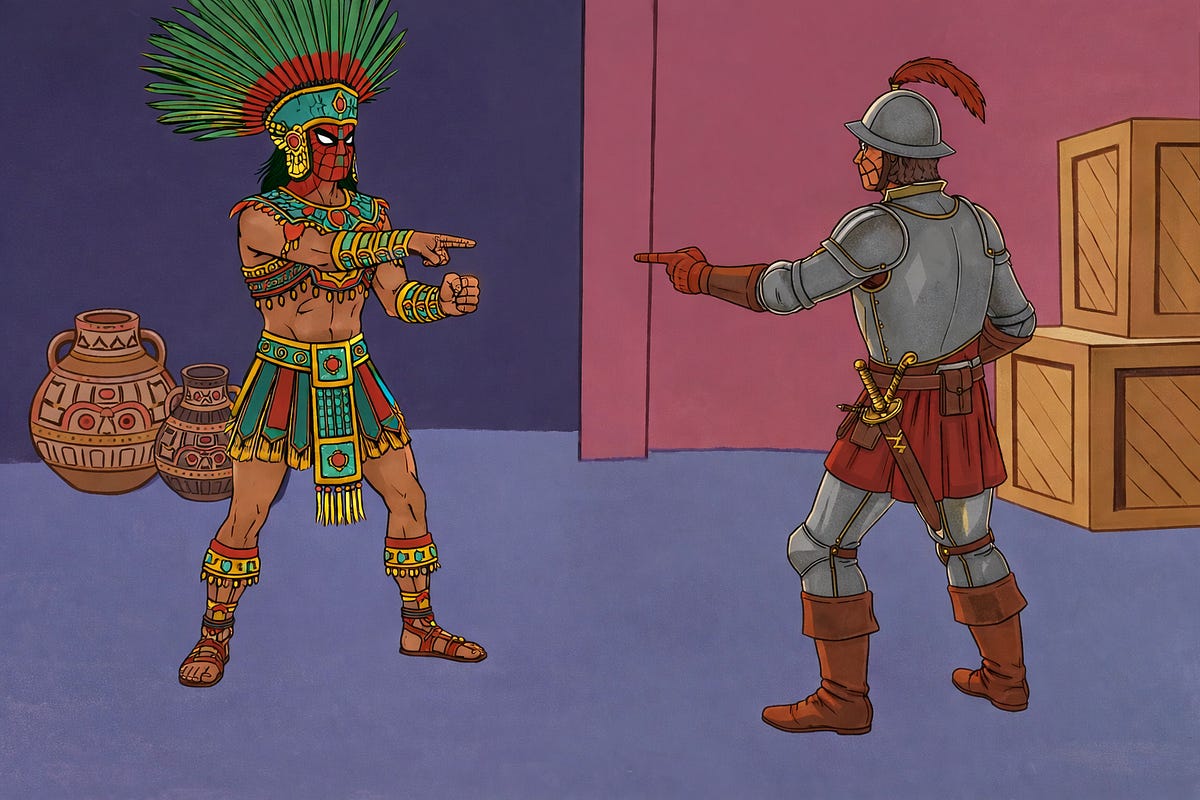
At a high level of abstraction, it may appear that there are numerous convergences between the Spanish and the Aztec. Yet, when you take a closer look at the empirical details, it becomes clear that both societies in fact differed significantly in not just their cultural window-dressing but across many critical technologies. This includes many of the very technologies highlighted by BBE as notional examples of technological convergence.
For instance:
whereas both the Aztecs and the Spanish had metallurgy, the Aztecs focused this craft on status objects and ornamentation, and the Spanish on utilitarian applications (tools, ploughs, armor, weaponry); by contrast, the Aztecs produced obsidian blades sharper than some modern surgical steel, being able to explore the physics of volcanic glass. However, obsidian was not otherwise equivalent in its properties to metal (being far more brittle), and so this is not simply a case of the Aztec utilizing a superior local resource unavailable to the Spanish; rather, it either enabled or forced a genuinely different path for the actual societal application of metallurgy;
whereas Spanish road transport systems were focused on animal traction, the Aztec urban design and transport system was much more water-centric in its emphasis on canoe transport across dense lake and canal systems. It’s not that a lake was a completely alien biome to the Spanish; but their cities and urban infrastructure of even their lakeside cities never adopted these kinds of urban infrastructure.
Certainly, in their agriculture, both the Spanish and Aztec used irrigation, but the latter developed a highly distinct form of ‘chinampa‘ hydroponic irrigation, optimized for moisture retention on small areas of lake beds–one of the most productive agricultural systems (in terms of land-use efficiency) produced by pre-modern humanity, allowing up to seven harvests per year. By contrast, after the Conquest, the Spanish drained Lake Texcoco to control flooding, introducing their own, different agricultural practices around water control: in the short term, this led to catastrophic local famines; in the longer-term, the new agricultural practices had significant ecological, social, and urban consequences.
Both civilizations had the written script, but the Aztec Nahuatl script, derived from the Zapotec, was semi-phonetic but largely pictorial, and served better in ritual traditions (codices), whereas the alphatic script used by the Spanish lend itself much better to precise legal, bureaucratic, or commercial record-keeping.
Both used calendar systems, but amongst the Aztec this system was not so much a tool for universal time-setting, but a social technology much more actively oriented towards legitimizing authority, with rulers able to claim divine backing by aligning their ascension with calendrical events.
Both civilizations certainly used weapons, but as the Aztec military was organized for the purpose of ritualized capture for slavery or sacrifice, the weapons it used were optimized for incapacitation rather than annihilation: for instance, macuahuitl blade clubs featured spaced rather than contiguous blades to limit wound depth, along with a heavy wooden construction that allowed initially weakened opponents to be easily clubbed unconscious with the flat side of a weapon. By contrast, Spanish weapon systems were oriented towards wars of total destruction, including the lethal annihilation of opposing forces through artillery or cavalry charge (as also seen, some decades later, during conflicts such as the Eighty Years’ War).For instance, Santi Ruiz has noted that: “Of course Tenochtitlan was the center of an incredibly powerful political order, larger than every European city bar Constantinople. But its success held the seeds of its downfall. An empire that had reached its apex through killing had spent several generations training itself to fight only to wound and capture, the better to harvest sacrifices with. The conquistadors were saved from slaughter largely because Aztec warriors competed to capture rather than kill them.”
Though both societies possessed numeral systems, these were base-20 in the Aztec case, and base-10 in the Spanish case. While these might be considered surface-level differences, which do not change what a mathematical system can express, different bases do affect the practical, actual use experience of a number system (more on this below).
Relatedly, while the Aztecs possessed highly sophisticated arithmetic for astronomy, they did not embed this in material computing instruments akin to the European abacus, astrolabe, or navigational tables, highlighting a difference in epistemic infrastructure.
Contrary to the BBE assertion, the Spanish conquistadors at the time of the conquest did not wear cotton (a luxury import from the Levant and Egypt). Rather, they wore wool, and linen for shirts and undergarments, and hemp used for ropes and rough textiles. While the Spanish conquistadors did, due to armor shortages, adopt the native quilted cotton jackets (escaupil) used by Aztec warriors, they also retained the use of leather jackets, and in any event this was not an independent convergent innovation or Spanish mainstay.
Let’s do a few more:
Innovation and production: as a potential meta-technology: the Spanish operated a centralized system of guilds (regulated apprenticeships, controlled technical secrets, limited entry) as well as state- or noble patronage support for innovation (e.g. royal armouries), with major innovation centers urban and coastal. By contrast, Aztec crafts were decentralized, focusing on household-level specialized workshops, most scattered throughout villages across the empire. Both had different advantages and disadvantages; a guild system ensured a high degree of quality control, but did risk cartels, price collusion, and monopolies. An open decentralized crafts environment (not unlike the modern open source ecosystems) was more reliant on slow, repeated interactions with other artisans, with products utilized within relatively small local communities;
Inheritance systems and norms can be considered a social technology. However, there were significant differences: the Spanish combined monogamy with primogeniture–succession by first-born. The Aztec combined polygamy with norms by which any son from any wife (even enslaved wives) could claim his father’s inheritance, resulting in large groups of potential claimants engaging in ‘dynastic gang warfare’ whenever a senior leader died.
On the BBE view, the Aztec-Spanish differences were cosmetic, operating around a common sociotechnical operating system that had scoped out and converged on the obvious efficient solutions. In reality, that’s… plausibly incorrect to a large degree. Rather, while there were some similarities, Aztec and Spanish societies differed amongst: (1) the actual artefacts and technologies deployed to achieve similar social purposes; (2) their designs and material properties, (3) their technology prerequisites. Moreover, in some cases, the technologies even served different forms of underlying societal functions.
Moreover, their technologies differed in ways that were certainly conditioned by variations in available resources or ecological constraints, but yet not fully or even mostly explained by these factors; and they differed in ways that had relevant societal consequences for the internal power distribution and the external competitiveness of either society, as well as for the welfare and freedom of their citizens.
III. Premodern pluralism: many civilizational functions are multiply technically realizable
This pattern is normal, not unusual.
For instance, when we look at each of the broader examples of convergent technologies offered by BBE, are any of these ‘technologies’ truly functional civilizational universals, or even dominant practices that isolated civilizations arrived at?
Let’s consider…
…intensive agriculture…
Not all settled, sedentary societies adopted intensive agriculture.
The Calusa were a powerful Florida chiefdom which–like the Spanish of the time–had an aristocracy and hereditary monarchy, and built at a large scale (e.g. great houses that could hold up to 2,000 people). Yet they did not practice agriculture; their society was instead built on smoked fish, shellfish, and estuarine resources, including in water-courts to store fish covering 6,000 square km (Kemp, pg 60). The Calusa were aware of the possibility of agriculture–indeed, they dominated neighbouring Apalachee and Timucua cultures which were engaged in maize farming, demanding frequent tributes of captives–and yet they saw it as beneath themselves, and dismissed and resisted Spanish colonial attempts to introduce agriculture (and, while they were eventually subsumed, they held out for far longer against the Spanish than had the Aztec and Inca empires).
The Pacific Northwest Coast peoples were fully or near-fully sedentary, with large permanent villages, large-scale architecture (longhouses, totem poles), hereditary social stratification, slavery, legal and ceremonial systems (potlatch), and long-distance trade–sustained by salmon, marine mammals, and shellfish, rather than farming.
Jōmon Japan (c. 14,000–300 BCE) is a more contested example; a pottery-using, semi-sedentary culture that existed for thousands of years in an intermediate stage of primarily subsisting on hunting, fishing, and gathering, with only very limited animal husbandry and horticulture.
In all, a review of past and present foragers found 17 examples of unequal, stratified and complex hunter-gatherer societies that were sedentary or at least semi-sedentary, which did not rely on agriculture, and which in many cases lasted for many thousands of years.
This is not surprising: sedentism and complexity require storable surplus: that can be provided by agriculture; by taxing or looting farming neighbours; or without recourse to agriculture, through aquatic or other resources that provide predictable, dense and storable calories. However, that does not mean that these differences are entirely explained by available resources: as noted, other societies peoples that found themselves in the same regions did engage in agriculture.
… Agriculture with irrigation and terracing
To be sure, many settled societies did independently develop means of working the land to cultivate crops (or subsequently imposed this on enslaved neighbouring hunter-gatherers). Yet even here the technological differences were both real and pronounced in their effects.
Whereas Europe, the Middle East, and most of Asia focused on agriculture by plow, certain parts of sub-Saharan Africa, the Americas, southeast Asia and Oceania developed hoe farming. Critically, the latter is much more productive per hour of labour, though it requires larger tracts of land, relative to the physically intensive plow agriculture which can support larger populations on smaller land through back-breaking labour. This divergence has resulted in plow agriculture derived societies that even generations later, are much more gender-unequal, since economic productivity was much more tied up with male physical strength.
In turn, while all plow societies farmed by the, er, plow, European farmers for millennia were stuck with the very inefficient ‘slab’ plow, before finally adopting the much more efficient moldboard plow in the 17th Century (thereby utilizing an invention that China had run with since the 1st Century).
Many societies experimented with different forms of planting infrastructure, with different implications: for instance, many European societies focused on a system of crop rotation (ie. sequential cropping over time, in one location); in contrast, North American societies pursued a form of polyculture (simultaneous intercropping): the ‘Three sisters’ technique was an indigenous companion planting technique in meso- and North America which involves planting corn and (climbing) beans together in mounds, and then planting squash on either side of the mounds (the corn provides the physical trellis for the beans to climb to sunlight; the beans fix atmospheric nitrogen into the soil, fertilizing all three plants; the squash grows on the ground, suppressing weeds and retaining soil moisture). The European approach ensures stable productivity over many years (and later proved more compatible with mechanized farming), whereas the American approach ensured a higher yield per unit of land within a season
In China, India, and the densely settled islands of the Indonesian archipelago, water buffalos and oxen were the draft animals of choice, because they are highly efficient in net energy terms, and because they can largely graze on grass and straw. This made them more suitable for a context where ecology had supported a paddy field rice agriculture that had significantly boosted population densities. By contrast, horses are much stronger and productive draft animals per hour of human labor, but they are very inefficient in terms of land; as such they were adopted only by groups with initially (relatively) low population densities and large amounts of arable land (e.g. notably European colonists in Australia and North America);
Fertilization: Japan developed a sophisticated market economy around urban night soil (human excrement) sold to farmers; the technique, which allowed for nutrient recycling, greatly boosted productivity, relative to European societies that were more squeamish about this. Amongst other approaches, England and Persia used Dovecotes (pigeon towers) for mass fertilization, a solution that went entirely unconceived in numerous other areas with both fertilisation needs and bird populations. Pre-Columbian Amazonian peoples created highly fertile ‘dark earths’ soils by incorporating charcoal, bone and organic waste. This is in addition to a number of other approaches (marling, plaggen agriculture) that I’m less well read up on. A number of these technological differences could be explained by prevailing climatic conditions, but far from all.
likewise, the use of ‘fruit walls‘ allowed 1600s Northern European societies to grow Mediterranean fruits and vegetables in cold conditions. In fact, in the modern era, the use of ‘fruit trenches’ would allow the early Soviet Union to corner the global citrus market, by growing subtropical plants in temperatures as low as minus 30 degrees.
…Cities with rectangular street grids centered on public plazas
(note, some of these are taken from Luke Kemp’s Goliath’s Curse, as well as Redwood & Bigon 2018).
Çatalhöyük (7100-6000BCE), the largest known conurbation of its age, had no streets or central plazas, nor any distinctive ‘central’ or elite buildings;
while Babylon did have an orthogonal street grid, it was unusual in this amongst Mesopotamian cities, which generally ‘contained planned temple and palace complexes but unplanned neighbourhoods and areas of industry.’
the Harappan (Indus Valley Civilization) had some basic urban planning, but lacked any monumental temples, plazas or palaces; moreover, while some of their cities were gridded, later South Asian capitals such as Pataliputra followed the topography of the land to a much greater degree;
Mayan capitals such as Tikal and Palenque were emphatically non-gridded, instead following terrain, sightlines, or astronomical alignment
the Mesa Verde cliff dwellings used communal dwellings accessed via ladders, with intervening ritual spaces;
Great Zimbabwe had no central street grid, with authority expressed by spatial separation;
Ifé (or Ile-Ife), an ancient Yoruba city founded between 1,000 BC and 500 BC, was fractally organized, in ways that prioritized lineage and status
for much (though not all) of its history, Teotihuacan, a massive early mesoamerican city (100BCE-550 CE) was planned, but rather than centered on a single plaza or center of power, its Avenue of the Dead runs for many kilometers, with multiple pyramid complexes along it, along with standardized housing compounds, implying centralized ritual power but collective organization and decision-making.
many medieval Islamic cities (e.g. Fez, Marrakech) explicitly valued labyrinthine designs, with winding alleys and irregular routes, for their benefits in defense, where they confused and slowed invading forces
many societies developed ‘linear settlements‘, groups of buildings formed in a long line along a transport route, lacking an obvious centre.
Even in cases where different societies did independently develop (or adopt) gridded cities, the rationale and function served by this technology differed:
in Roman castra (military forts), the gridded and open layout served purposes of efficient internal troop communication, movement and defense;
in American colonial cities, grids facilitated colonization and administrative control
in Imperial Beijing, the grid was laid out on cosmological axes and ideological, aiming to spatially represent a neo-confucian ideology whereby the sacred emperor resided at the centre of the universe.
During the Renaissance, engineers such as Filarete sought to build concentric cities, with non-rectangular, radiating streets that imposed geometrical harmony, in order to reflect humanist principles and realize the egalitarian ideals in Sir Thomas More’s then-highly-influential novel Utopia. This circular design was then seized upon and further reinforced by military planners, who hoped that the circular form could be the centre of star polygon (trace italienne) forts that were resilient to cannon fire.However, the design created tension between military needs (with planners seeking to ensure that streets connected to the gates did not run directly to the central plaza–so enemies passing through the gate would not be able to advance or fire straight upon the city centre) and civic interests (who preferred a direct connection between the gate and the central square for ease of traffic). In the resulting cities, such as Palmanova, the supervisors (the Senate of Venice) tried to give priority to civic interests over military concerns, with a wider and more direct infrastructure. This compromise resulted in a city that was imperfect either from a military or a civic point of view, and by 1622 Venice was forced to pardon criminals and offer them free building lots and materials if they would agree to settle the town.
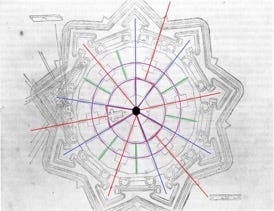
Palmanova’s original military plan
… Concept of zero
while concepts of zero or negative numbers emerged in Indian and Arabic mathematical systems developed around algebra, they did not in systems that focused more on geometry. As such, many major civilizations–such as the ancient Egyptians, Greeks, and Romans–did not conceptualize or adopt the concept of zero, even though they had terms for ‘nothingness’ in their language, and even though they encountered mathematical problems where it could have been useful. Western mathematics derived from the Greek mathematics, developed around geometry, which had little need for zero. In fact, this was not just a passive oversight: the Greek strongly resisted the idea of mathematical zero (and infinity) on philosophical grounds, arguing that these concepts were not grounded on any logical basis.As Reviel Netz notes in A New History of Greek Mathematics, “For the Greeks, “number” meant what we think of as a positive integer (usually not always – the Greeks excluded the number 1 itself, which was not so much a number as the “unit” by which numbers are measured)“ (discussed by Joseph Levine).
More broadly, while numbers are nearly universal (though again excepting cultures such as the Pirahã), number systems developed in many different directions: in Roman and Chinese systems, base-10 won out. However, many other systems are common throughout world history: base-4 in the ancient Indic Gandhari script; base-5 in indigenous America and in West Africa; base-12 numeration in parts of Nigeria; base-20 in Aztec and Maya numerals as well as Celtic numbering systems, base-27 in Papua New Guinean languages;There may even be evidence that some groups such as the Yupno (Papua New Guinea) have gendered counting systems, where the men count in base 33 and women count in base 30. base-60 in Babylonian cuneiform numerals.
- These are not irrelevant, surface differences: while different bases are mathematically commensurable, such that the numbering system does not change what a mathematical system can express (in terms of e.g. arithmetic, algebra, calculus), the base used does affect how often fractions terminate (versus how often they infinitely continue, e.g. ‘10/3 = 3.333333’), how compact numbers look, and how easy mental arithmetic decomposes. it therefore changes how many humans (in practical usage) think, calculate, teach, record, and institutionalize numbers. For instance, Babylonian base-60 was very fraction-friendly (few infinite decimals); that meant it was well-suited to bureaucratic accounting practices and to astronomical and calendar calculations; but it has too many different symbols to lend itself to daily arithmatic. Conversely, while base-10 lends itself easier to childhood teaching (e.g. relying on finger counting), it is not actually cognitively optimal, with infinitely repeating fractions for 1/3 and 1/6 fractions. By comparison, base-12 might actually be cognitively easier: more divisible, small multiplication tables, cleaner fractions. It is for that reason that the Romans used a duodecimal rather than decimal system for fractions. The lock-in of base-10 may be as much due to the contingent success of some societies and their education systems.
Even amongst base-10 systems, there were notable differences that affected the relative ease of different mathematical operations: for instance, multiplication was considered one of the more advanced concepts in Roman mathematics, since it is so difficult to do with Roman numerals, which is not positional;
Finally, the societal role of mathematical systems differed significantly, such that, for instance, significant advances by Chinese scholars in mathematics, astronomy, and the natural sciences between the 16th and 19th century ‘had virtually no impact on state-sponsored astrology, which—when expressed in calendars, almanacs, and officially mandated rituals—quite literally dictated the rhythms of Chinese political, social, and ritual life at all levels.’
… Cotton dyed into clothing
At least prior to the Greco-Roman period (first millennium BCE), ancient Egypt mainly used linen or wool–even though it had traded with the Indus Valley Civilization, a major cotton producer and exporter, since around the 3rd millennium BCE, and it had seen limited indigenous cotton cultivation as early as 2500 BC; Ancient Rome similarly preferred wool with linen for undergarments
in the Philippines, indigenous clothing was based on fiber from the abacca (Manila hemp) plant
in the Iron Age, continental Europe saw a range of wool-linen blends, with pure wools dominant in Northeastern Europe, and pure linens in the Middle East
in Medieval and Early Modern Europe, wool nonetheless remained the dominant fabric, followed by linen and hemp, with cotton being expensive and uncommon. Even when cotton became more available, it was often actively resisted: for instance, the British Calico Acts of 1700 and 1721 banned the importation and sale of finished cotton goods from India, to protect their domestic wool and linen industries
Revolutionary War-era American minutemen, and working men generally in New England, tended to eshew cotton or linen, and rather preferred various types of woolen garments, which would last longer and kept one comfortable over a larger span of the year;
moreover, designs of elite clothing varied significantly with norms: for instance, Renaissance Europe operated sumptuary laws, clothing restrictions justified as preventing overspending on vanity, restricting expense for each rank.
The multiple realizability of clothing is in fact underscored by the fact that the original emergence of clothing in hunter-gather societies was not only for the single goal of shelter (i.e. thermoregulation), but has been linked to fairly diverse functions, not just thermoregulation but also modesty purpose, body armor, camouflage and visual deception.
…used currency for trade
the Inca notoriously ran an empire of perhaps 10 million people without a monetary system; they did so by utilizing central warehouses, leveraging their sophisticated road system for communication and goods transport, and (possibly) using a system of ‘spatial accounting’ consisting of fields of thousands of precisely aligned holes, used as spatial systems of accounting and exchange;
the Aztec, along with other New World societies like the Maya and Zapotec, never developed a centralized, coinage-based currency, and instead relied on multiple forms of non-coinage currencies involving common goods such as cocoa beans;
the Yurok (who inhabited the Northwestern corner of California) used white shells arranged on strings and headbands made from woodpecker scalps as wampum money; however, rather than being primarily utilized for trade in goods and services, such ‘currency’ existed instead keep track of social capital and political favours, with questions of material private property merely being an extension of the social relations so encoded
… Hierarchy with monarch at the top & hereditary nobility; Bureaucracies to administer taxation
I won’t aim to make a (more) exhaustive list, but historians generally have increasingly chronicled a fairly wide variation in state forms, with different levels of hierarchy, and centralization.
Athens adopted a system of sortition (random lottery selection of public officials); similar systems were used as the brevia in Lombardy (12th and 13th centuries) and in Venice (until the late 18th century), or as scrutiny in Florence for over a century in 1328;
Even nearby polities operating under similar cultural and geographic circumstances, such as Athens, Sparta, and Macedon tended to pursue distinct forms fiscal, administrative, and coercive practices, in ways that resulted in distinct levels of state capacity and capability for organizational learning;
the Cherokee developed a ‘Red/White’ system, which separated out parallel lines of leadership and government structure in peacetime and in wartime;
the Hanseatic League system emerged from individual traveling traders to a community of medieval German merchants, establishing strong supply chains between ports, as well as establishing coalitions for collective bargaining, action, and security. It did so without a head of state; rather, it operated through councils, guild rules, and trading privileges rather than bureaucracy: upon the road, merchant hansas (’groups’) would elect an alderman (literally ‘elder man’) to represent them. The League would eventually grow to the size of hundreds of member cities, and lasted for nearly 500 years, far outliving the average lifespan of empires and states (approximately 201 years, with huge outliers).
Even in societies with nobilities, there were significant variations:
bureaucratic feudalism in China protected against the rise of a mercantile class, powerful enough to affect governmental policies as it happened in Europe, and therefore reduced scientific progress, but it created greater social stability.
after the Khitan (’Cathay’) nomadic horsemen conquered China, they adopted a mirror system of government, one ‘civilized’, the other ‘barbarian’, in which there were ‘two governments, two sets of laws, two taxation regimes, two writing systems,’ and in which the Khitan king spent half the year reigning as a Chinese-style emperor, and half of it touring around his nomadic subjects as Great Khan in a mobile court.
Even in societies where there are monarchs, there has been very significant variation in the status of elites, the form of rule, and the amount of autonomy relegated to members; for instance, a review of pre-colonial societies in sub-Saharan Africa found significant variation in forms of political authority, with forms of government ranging from ‘despotic’ (23%) to regal (46.8%) to ‘gatekeeper’ (23.3%) to ‘federation’ (6.9%).
Another systematic review of African polities calculates that in 1880, before colonization, there were potentially 45,000 independent polities across Africa, rarely organized on ethnic lines, with at most 2% of these being classifiable as ‘states’.
Note that this does not commit one to the idea (championed by e.g. David Graeber and David Wengrow in their The Dawn of Everything) that all of these forms were entirely the result of conscious political choices and knowing experimentation. However, it does show that far from functional convergence amongst isolated societies, there can be sustained divergence even amongst societies living alongside each other.
Moreover, far from non-hierarchical societies being necessarily constrained in their abilities, there is evidence that societies without prominent hierarchies could carry out large construction projects (I’ll say more about this in a follow-up post).
… Standing professional armies:
early Rome, classical Greece, and late medieval Swiss cantons used citizen militias; (the modern Swiss armed forces do have some a small standing military, but these are a small part of its larger system that is dependent on militia defense combined with widespread civilian firearms culture; the military has gone through repeated reforms to reduce the size of its standing military).
The Roman legions (especially after the Marius reforms) did deploy professionalized standing armies; however, it is a standing army that is heavily dependent on auxiliaries recruited from allied states. These auxilia become an institutionalized, stable part of the Roman army, making up at least half of the total strength of the Roman army between 23 AD and (likely) 212 AD). Under this system, these auxilia would be offered citizenship after service–creating knock-on effects on the ethnic, cultural and civic makeup of the empire.
the Icelandic Commonwealth (/ ‘Icelandic Free State’) of 930-1262 had no standing army and no centralised military command, though it had decentralised armed capability consisting of the followers of goðar chieftains
the Mongols and Celtic societies, and pre-Islamic Arabic tribes used clan levies;
medieval Europe and Japan used feudal levies;
Carthage and late medieval Venice relied heavily on foreign-mercenary armies; more generally, the Mediterranean merchant republics, relying on large fleets and condottieri-led mercenary armies, with a very high ratio of capital intensity to labor intensity;
the late Byzantine empire adopted a Theme system of hereditary landed soldier-administrators, organising provinces around standing armies, but fusing the offices of military commander and civil governor, and providing soldiers with state-owned farming land only the assumption that they promised their descendants would join the military;
the medieval Muslim empires, such as the Mamluk, relied upon military slavery , with many of these ‘Ghilman‘ slave-soldiers bought or taken from pagan societies as children, in a system that was very rare outside the Islamic world.
the Ottoman empire, facing over-extension, eventually complemented its elite janissary slave soldiers with Bashi-bazouk (’crazy-head’) irregular soldiers, recruited from its periphery and unpaid, rather incentivized with the promise of plunder and deployed under an expectation that they would support themselves through looting and preying on civilians;
To also take an example in the opposite direction: Sparta went to the other far extreme: it not only had a standing army, but developed a standing military that subsumed its entire (non-slave, male) population far more comprehensively than any others. Their agoge system drafted all Spartan boys from age seven into a brutal education system dedicated towards raising a standing fighting force capable of keeping said slave population in check. This however locked them into a form of societal organization that was particularly oppressive and brutal even to its most elite members; created a rigid social order that inhibited innovation and organizational learning; and which, through its overinvestment in hoplite warfare, actually resulted in comparatively poor battlefield performance.
And, with a brief modern excursion: some premodern states (arguably Ragusa/Dubrovnik), and many modern states (Andorra, Costa Rica, Iceland, Liechtenstein, Monaco, Panama, San Marino, Vatican City) have abolished or foregone a standing army, retaining only very limited paramilitary or police forces (Marshall Islands, Micronesia, Palau, Nauru, Tuvalu) relying instead on security assurances from allies. (you might argue that this is ‘cheating’, as it still involves someone having a standing army. Yet the fact of the matter is that adopting this approach is a distinct local societal option for responding to its security threats, which has distinct advantages, drawbacks, risks, costs, and social implications)
Significantly, all of these forms of military organization come with very different tactical, strategic and political characteristics, including: battlefield performance (on different terrains; and relative to different possible opponents); logistics needs and costs of upkeep in the field; ability to engage in long-range force projection or undertake sieges; the relative risk that troops engage in mutiny, uprising, or coup d’etats; the risk that they might change sides and join enemy invaders after early defeats; their propensity to engage in atrocities against (one’s own or the adversary’s) civilian population; and their institutional resistance to reform or modernization.
… Metallurgy (& armour)
while neither the Incas nor the Aztecs developed iron, both had copper; however, while the Incas saw some limited adoption of bronze in weapons, the Aztecs only used copper for civilian purposes, and stuck with obsidian for their weaponry. More generally, throughout the Andes, the use of metallurgy was primarily oriented towards aesthetic objects, rather than warfare or other practical practical technologies; in the Incan empire, textiles were often more valuable than gold, both economically and socially.
not all cultures have (consistently) settled on gold as high-status metal: the early Caucasus, an early center of gold innovation, saw a precipitous fashion-driven decline in gold mining around 1500 BCE
accordingly, many other cultures fought without metal armor, even though they possessed metalworking and could well have adopted it: mesoamerican cultures such as the Aztecs and Tlaxcaltecs tended to use ‘ichcahuipilli‘ quilted armour; many Mauryan and Mughal armies in India used quilted cotton, layered silk or leather armours; the Chinese Zhou and Tang dynasties tended to use standard lamellar armors of lacquered leather or rawhide, as did the Mongols; some early West African states did adopt chain mail armour (from the Mameluks), but others such as the Mossi emphasized layers of clothing for protection
other cultures used metal armor, but far less widely than they might have, or repeatedly varied its form: amongst the Greeks, linothorax (glued linen) armour was common even amongst well-equipped hoplites that could have adopted bronze; the Roman legionnairies initially adopted mail armour (lorica hamata) from the Gauls before moving towards scale armour (lorica squamata), their iconic banded metal armour (lorica segmentata), as well as quilted fabric armour in late antiquity
… The wheel
Many major New World civilizations (Maya, Aztec, Inca) had spindle whorls for weaving, used compacting rollers for use in construction of their roads, and even invented the wheel for use in pull toys; yet did not apply this obvious invention to carts or transport, relying instead on human porters, llamas, or canoe water systems.
between the 3th and 7th century AD, many civilizations of the Near East and Northern Africa gave up wheeled vehicular transportation (which they themselves had invented), and instead adopted camels for transport.
…Writing
It’s true that writing appears to have been invented independently several times (see e.g. Southern Mesopotamia, South-West Asia).
However:
the North American city of Cahokia had no writing system, but nonetheless lasted over half a millennium (AD 800-1350), with estimates of a peak population of 10,000 to 25,000 people, equivalent to London and Paris at the time.
the Inca ran their empire (of perhaps 10 million people) without a monetary system (and without a real writing system; instead they used their quipus knotted cords for basic accounting;
some Mesoamerican societies had writing systems, others did not–in a pattern that was not clearly correlated to their population size or complexity of their government (although those that did have writing systems tended to be organized in a more autocratic manner). For example, the Pre-Colombian metropolis Teotihuacan (100 BCE-550 CE) held perhaps up to 100,000 people; yet while there is a system of limited glyphs, it remains unclear if that constituted a complete writing system, and one that encoded a specific spoken language,Though for some recent work that does suggest that the system encoded an early Uto-Aztec language, see Hansen & Helmke. despite the fact that its people seem to have known about the writing systems of the Maya and the Zapotec.
many societies in West Africa, used Griot, bardic historians representing a centralized and often hereditary oral tradition (though in some societies, such as the Mali Empire, this was used in conjunction with, or underpinning, the use of Arabic)
The Luba people (a Bantu group in what is today The Democratic Republic of the Congo) developed the Lukasa, hourglass-shaped wooden memory boards covered with beads, shells, and metal, which aided in the recollection of important people, places, and relationships and events
Of course, it is likely that, even if you can have repositories of knowledge without a written script, you still need a script to be able to create the sort of legible accumulation of knowledge that could enable scientific evolution.
However, even then, that doesn’t mean that there isn’t a relevant difference between types of script. After all, the complexity, material requirements, and different styles of writing systems lend themselves to very different communicative efficiency and social structures, depending on their complexity and how accessible they were to learn. For instance:
Sumerian Cuneiform was composed of hundreds of logograms on clay tablets, making it difficult to learn, and confining its use to a scribal elite. This, along with the relatively cumbersome clay tablets, made it well-suited for administrative hierarchy and bureaucratic centralization, rather than public literacy;
the Egyptian hieroglyphics system contained parallel writing systems: a complex (hieratic) form for religious texts and literature, and a simplified cursive form (demotic) for administration and legal purposes. In addition, there are indications that the Egyptian New Kingdom used Akkadian cuneiform as a language of diplomacy
the Chinese logographic system existed of thousands of characters, some existing out of more than twenty-five strokes; more than two or three thousand characters must be memorized before one can read even simple texts;Interestingly, whereas many writing systems tended to become simpler and more abstract over time, the Chinese writing system appears to have gotten more complicated over time, even when accounting for the 20th century standardization push by the People’s Republic of China on Simplified Chinese characters. this enabled remarkable typographic stability and cultural continuity (with texts remaining legible for millennia), as well as cultivated administrative unity and cultural cohesiveness across dialect-diverse regions (improving imperial cohesion); however, it inhibited mass literacy until well into the 20th Century; and (possibly) did not lend itself well to adoption in printing systems; and certainly did not lend itself well to in telegraph communication, or in typewriters.
conversely, the Phoenician Alphabet afforded just 22 symbols to represent all words phonetically, marking massively lower literacy barriers and catalyzing commerce and economic networks;
before 1446, Korea had used Hanja Chinese characters, which were poorly suited for representing the Korean language, and difficult to learn. Accordingly, Joseon king Sejong the Great (r. 1418–1450) moved to create the Hangul alphabet; however, the adoption of this script was slow because it was looked down upon by the elite for centuries.
So much for the list of technologies surveyed by BBE. We can add in a few other technologies, for good measure:
… (Premodern) warfare:
Projectile weapons varied in their implementation details and characteristics; Europe, the Americas, and Africa focused on the self-bow (made from a single stave of wood), which is durable and easily constructed and repaired; the Middle East and Eurasia focused on composite bows (made from several layers of material), which is shorter than an equally powerful self-bow, and therefore makes it much more suitable for horseback or chariot archers; thrown spears and throw sticks prevailed in Australia; the Inuit developed ‘cable backed‘ bows, etc.
interestingly, “In the 1930s, American scientists set out to discover the optimal shape of a bow. To their surprise, they found that the D-shaped profile of the longbow – the only known historical western design at the time – is not the most efficient one. Rather, a rectangular cross-section works best because it induces more uniform strain across the limb’s width. That makes the bow less prone to breakage.”
Moreover, archeological studies suggest that, rather than bow and arrow replacing the earlier dart-and-atlatl weaponry in the Americas, they coexisted for thousands of years, serving specialized functions;
contrary to widespread perception, the Chinese did utilize gunpowder for weapons, though early innovations focused more on flame-throwers or ‘fire lances’ (e.g. single-use spears with containers of gunpowder mounted on top); later developments of firearms technology (after its invention during the Song dynasty) soon petered out, failing to keep pace with the West’s weapons in spite of Chinese awareness of those technologies;
In terms of medieval naval craft, while many societies discovered and used the sail, there were many variations on complementary propulsion technology: Vikings used the longship, which enabled both sea voyages and up-river raids; European powers used sail-driven carracks; Chinese naval strategists, facing fights for the control of strategic inland waters, rivers, and lakes, frequently relied upon paddle-wheeled craft powered by their crews
Horse archers were a ‘superweapon’, but were so dependent on their underlying societal form that they couldn’t long persist outside of the geographical context they originated in.
Such relative variation in premodern weapon systems is unsurprising, at least for premodern societies, where–with a few rare exceptions (e.g. Mesopotamian chariots and Chinese cross-bows)–technology was an important factor in war but was rarely determinative of military victory (see Raudzens).I’ll likely explore this debate and various arguments in a future post.
…Timekeeping:
While many (though not all) societies independently invented and used some water clocks, many other versions vary:
Europeans developed mechanical clocks after 1300 CE, in large part driven by Benedictine monasteries’ needs for syncronizing human monastary activity into an orderly routine
Mesoamericans invested heavily instead in (astronomical) calendrical systems with extreme accuracy; but not “clock time”. Their temporal interest focused on longer agricultural, ritual or astronomical cycles, not the division of a day into units for coordination;
The Japanese predominantly used water clocks (like many other societies); yet when Jesuit missionaries introduced them to spring-driven mechanical clocks, they reverse-engineered them to wadokei, clocks with adjustable plates to display variable hours that changed with the season, in accordance with traditional Japanese time in which daytime and night-time are always divided into six periods.
… Information Storage
As a slight variation on ‘writing’:
Xylography printing (woodblock printing of entire pages, rather than characters as in movable type) was invented in China in the 8th century AD, and became the dominant Chinese printing method for many centuries, even long after they had also invented typographic (movable type) printing around 1040. In Europe, xylography appeared in the late 14th century, but after the appearance of Gutenberg’s movable type, it was rapidly (within decades) phased out. People often argue that block books were not suitable for the mass dissemination of ideas to an audience; yet they were more than sufficient to spark an intellectual and cultural renaissance in China, although their bookmaking skills had declined by the 15th century. By contrast, the dominance of Chinese xylography was such that some historians have estimated that a majority of the world’s printed pages up to the 1500s (and possibly 1700s) were in Chinese xylography, not the European movable-type printing press.
- The usual explanation for Chinese retention of woodblock over movable-type printing, points to the complexity of the Chinese logographic writing system, which makes using movable type impractical compared to woodblocks, whereas the small Latin alphabet made movable type vastly more efficient. However, as studied by Basalla, there is evidence that Chinese artisans were able to produce woodblock prints at a rate competitive with European type-setters (see also Angeles); Chinese resistance to xylography seems to have had a lot to do with their aesthetic preference for the higher calligraphic quality of woodblock prints over (early) movable-type prints.
the Ottomans were aware of the European printing press, but nonetheless waited almost three centuries to sanction printing in Ottoman Turkish; it has been argued they restricted or heavily regulated the printing press in order to prevent the loss of revenue that would have been caused by potentially undermining the legitimacy provided by religious authorities. (though note, a more in-depth account is given by Anton Howes, who notes that restrictions mainly applied to non-Muslim printers using Arabic characters; and that the lack of uptake of printing by domestic Muslim printers was inhibited by the greater expense of printing Arabic script, and a lack of interest from the ruling Sultans (contrary to direct support by European rulers).
As discussed above, the Inca used quipu knotted string information storage; we can decode the numerical system but the potential linguistic content remains largely opaque ,-possibly because the reading required accompanying oral context now lost.
the Iroquis Confederacy and other Northeastern indigenous peoples utilized Wampum belts, which used shell beads in patterns to encode treaties, histories, and agreements. These weren’t just mnemonic devices but held legal force.
In Micronesia, Marhsall islanders developed stick charts that represented major patterns in ocean swells and the way the islands disrupted those patterns. The encoding of such ocean swells was never before achieved, though the maps were studied and memorized prior to voyages, and could only be read by the designers.
… Local land transport:
- The wheelbarrow was developed in China in the 2nd century CE, but only made it to Europe in the 13th century; the same pattern held for the much more efficient wheelbarrows with a centrally mounted wheel (invented in China around 430 CE; only adopted to a limited extend by Europeans in the 1600s).
… Oceanic navigation:
Early modern Europeans, oriented towards long-range naval trade and colonization, invented tools such as compasses, sextants, and later marine chronometers;
Vikings may have used ‘sunstones’–dichroic, polarized spar crystals–as reference optical compasses that allowed them to locate the sun’s position and steer on cloudy days, and used it centuries before the introduction of polarization of light in optical theory
Polynesians developed highly sophisticated non-instrumental navigation (stars, ocean swells, birds) to solve ocean voyaging; these had their own benefits: reading ocean swells isn’t necessarily the most efficient method but it might be the most effective and reliable, particularly when other devices failed or were unavailable (e.g. because of cloud cover);
The seven Ming treasure voyages involved a class of naval vessels far larger than those developed by the Europeans; then burned them–and their records–for political reasons.
… Legal Systems:
If we consider legal systems as a social technology,If laws are a social technology… does that make the EU the world’s largest Tech Company? we can see a wide range of variation amongst legal systems (see also Friedman 2019 (and Scott Alexander’s review), including some systems that lack features that are considered absolutely essential to a legal system by classical theories of law (e.g. Fuller’s Principles of Legality).
Indigenous American populations responded to crime with a system of social pressure on an offender’s lineage or clan to pay compensation) in order to leverage intra-familial social pressures to prevent recidivism;
the positive law of Han China struck a compromise between ‘Legalist’ philosophers (which believed in driving crime to zero through publicized, written laws enforced by harsh penalties, with equal treatment under the law), and Confucian philosophers (who thought that society should depend on moral virtue more than law; that a written law code that was generally available would just lead to criminals exploiting legal loopholes; and that the law should impose unequal legal treatment based on the unequal status of its subjects). In this compromise, legal codes existed but the Confucian ideal of rule-by-virtue remained dominant; penalties were calibrated by family hierarchy; and while some law codes were available, the fact that most people were illiterate, and that private law practice was illegal, meant that people were dependent on government officials for all knowledge of legal rules.
Or, to take some other cases:These are taken from (Hadfield & Weingast and Carugati, Hadfield & Weingast).
Democratic Athens never developed extensively centralized rule of law institutions (police, public prosecutors, professional judges), and instead sustained legal order for over 200 years through a coordinated legal order based on a common-knowledge system: massive juries of hundreds to thousands of citizens, who judged through public proceedings in the Agora, in a manner accessible to all male citizens (on whom enforcement depended), ensured that common knowledge and recognition of legal outcomes spread fast and wide; because litigants could argue from informal norms, character and civic duty (rather than from written law), this made it more likely that verdicts tracaked community norms, and more likely that ordinary people would respect and enforce them (rather than e.g. help a friend against a stranger)
Vikings in the medieval Icelandic Commonwealth sustained a complex legal order for centuries, based only on elaborate rules memorized and recited orally by a designated Law Speaker. There were no police, army or enforcement apparatus. Enforcement relied entirely on outlawry. The system worked because participation in ostracizing outlaws was itself a coordination problem—you needed assurance others would treat your retaliation as legitimate, not as a new offense.
During the California Gold Rush (1848-1850), California had no legislature, courts, police, or jails. Miners self-organized by holding meetings to draft camp codes specifying claim sizes, marking requirements, and forfeiture rules. Most codes limited each miner to one actively-worked claim. Disputes went to ad hoc juries or arbitrators. Enforcement came from a collective willingness to expel illegitimate claim-jumpers or defend legitimate ones.
Amongst 11th-14th century merchants, various institutions emerged to solve problems such as enforcement gaps (for long-distance trade): Maghribi traders used cultural beliefs about collective responsibility to coordinate boycotts of cheaters; merchant guilds enforced rules through exclusion and required members to use guild courts exclusively; the German Hansa coordinated multi-city boycotts against rulers who violated merchant charters.
… Family structures and child-raising practices
There is very significant variation amongst marriage customs, which often intersects with other technological choices (e.g. the form of agriculture or animal husbandry practiced) to produce extremely different social and gender norms. Amongst others:
Among the Nuer of South Sudan, a dead man’s family members could marry a wife on his behalf (’ghost marriage‘); all children born of the union legally belonged to the deceased, carried his name, and inherited his cattle, in a practice that was nearly as common as marriage among the living;
Himba pastoralists in Namibia practice polygyny alongside widespread female sexual autonomy; genetic testing revealed an extrapair paternity rate of 48%, with both men and women accurately identifying which children were biologically whose — yet husbands raise all children regardless, since cattle inheritance runs matrilineally, removing the paternity anxiety that drives mate-guarding in patrilineal societies;
The BaYaka of the Congo Basin have no marriage ceremony whatsoever: a couple walks into the forest, returns days later, and builds a hut; the man performs a year of ‘bride service’ hunting for his wife’s family, and divorce simply means one partner wanders off and builds a hut with someone else;
Polygyny combined with livestock farming can lead to shifts in inheritance and marriage customs: when Bantu-speaking cultures in sub-Saharan Africa adopted cattle livestock farming, patrilineal families started to outnumber matrilineal ones, as sons could use inherited wealth to acquire more wives they often changed to patrilineal systems.
There has been tremendous variation, across time and space, in the child-care and -rearing practices considered normal and essential by different societies. Sometimes expressed in significant differences even amongst adjacent tribes and societies.
What other seemingly universal human needs are more tolerant to variance?
Patterns
This is not even a complete survey. I’ve also obviously been selective–focusing on points of difference and divergence, rather than domains of convergence. There are also a range of possible objections that I’ll take up in my next post.
However, for now, this list helps illustrate that:
while many societies have common social needs (shelter, food, security, …); and while these often receive some technological response in complex societies, there is a reasonably high degree of latitude in the technological artefacts or systems that different societies have historically developed to address these problems.
These different technologies are rarely if ever equivalent in their traits or efficiency: however, they often are efficient or at least adequate (in isolation) solutions to the particular versions of social needs that a society (perceives itself it) encounters (e.g. European wars of total destruction versus Aztec wars aimed at incapacitating and capturing slaves and sacrificial victims).
while there are cases of multiple independent adoption of similar technologies, many societies historically did not hit upon similar ‘universal’ technologies even when they well could have. In fact, in many domains, isolated civilizations diverged on their technological solutions to a degree not (just) explained by differing available resources or climatic conditions.
These differences are not irrelevant surface variations or mere differences in material (e.g. writing on clay tablets vs. papyrus); rather, these differences mattered in terms of the political structure of a society, and in terms of the welfare and/or freedom of its people.
indeed, implementation details and particular design choices matter greatly: differences within a particular ‘technology class’ (e.g. composite bow vs. self-bow; crop rotation or poly-cropping agriculture) may matter as much or more than societal differences as societal differences between different technology classes.
divergent premodern tech paths were (with a few exceptions) not usually the result of a conscious or deliberate technological choice amongst alternatives. However, that is likely because (1) few premodern societies entertained a strong expectation of technological progress, and (2) in fact most premodern societies were not engaged in ‘grand strategy’ or long-term decision-making on any issues, and acted mostly reactively.At least in a form that we would recognize as such. For instance, while historians have questioned the account of Roman ‘Grand Strategy’ proposed by Edward Luttwak, surviving sources on troop movements in the Roman empire suggest that emperors decided how to allocate resources empire-wide to meet objectives: this suggests that they at least thought about grand-strategic issues even if they did not engage in long-term systematic strategic planning per se.
Thanks for reading Critical Maas! Subscribe for free to receive new posts and support my work.
Ultimately, claims about strong independent historical technology convergence either assume very strong artefactual convergence (e.g. ‘all societies must develop crop rotation’), in which case they are false, or only weak functional convergence (”complex agricultural societies have irrigation”), in which case they are abstractly right but say very little about the latitude of options we have in configuring future, other technologies.
If the actual implementation of ‘AI-enabled automation’ in the modern economy affords even a fraction of the flexibility in forms of implementation as we have seen in agriculture, transport, or writing, then we have a fairly good amount of latitude indeed.
Acknowledgements: thanks to Luke Kemp, Janna Tay, and Jake Slosser for discussion of a few of the cases discussed above.
Comment on Substack · Subscribe to Critical Maas · All essays